0 to 1, 1 to 10, 10 to 100: Three Ways of Working with AI
Boris Cherny, the creator of Claude Code, recently described his "fairly vanilla" process for using his AI coding tools. He then listed twelve steps, including running between five and fifteen Claude Code agents throughout his day, each handling different parts of his work.
I was pleased when I saw the thread because, as an avid user of Claude Code, I recognised many of the practices he was describing. But I also laughed when I saw someone quote tweet it with the phrase: "this is anything but vanilla."
To Boris, it was vanilla because he is so used to working this way. He had spent months, now years, rebuilding how he approaches engineering, including now inventing a tool that is helping other people to do engineering in a new AI-augmented way. What looked extraordinary from outside was just how he worked now.
I also thought: this is not vibe coding. It is something else entirely. These reflections got me thinking. We need a better framework for the different ways people work with AI. I've started thinking in three buckets: zero to one, one to ten, and ten to a hundred. These aren't points on a single ladder. They're different relationships with AI. And they carry very different emotional valences.
Zero to One: AI as Enabler
This is what happens when AI lets you do something you couldn't do before. Someone with no programming background uses vibe coding to build a basic app. An expert in one field uses AI to get up to speed in another. AI isn't making you faster at something you already do. It's opening a door that was locked.
This bucket gets the breathless coverage. Barriers falling, gatekeepers losing power, anyone can create. It is what David Kaye calls the zone of excitement: AI enables capabilities people desire but cannot achieve themselves. Type a prompt, get a song. Describe an app, watch it appear.
There's often an assumed ceiling here. Vibe coding produces basic apps. AI-assisted exploration produces working knowledge, not deep expertise. Sometimes true. But zero-to-one vibe coding can also be a gateway drug. Some people keep going. Not everyone stops at one.
One to Ten: AI as Accelerator
The second bucket is where you already have real capability and you're using AI to go faster, do better, or work at greater scale. The productivity promise: same work, more of it. Your expertise, amplified.
This one's messier than it looks. Sometimes AI makes you faster. Drafting, first versions, repetitive tasks. But sometimes it adds friction. You produce text faster but spend longer editing. Code generates quickly but reviews bottleneck. You generate more options but drown in choices. The gains come with asterisks.
There's a question lurking here about what "10x" even means. The idea of a 10x engineer predates AI. Some engineers are better than others. Some have more experience. Some can do more. Some can go faster. Could AI help to accelerate people on that journey to both mastery and productivity? That is the 1-10x question.
Ten to a Hundred: AI as Transformer
The third bucket is different in kind, not just degree. You're not doing the same things faster. You're rethinking what's possible.
This demands a rare combination: deep expertise in your domain, real fluency in AI, and willingness to tear up your existing workflow and start over.
Simon Willison calls this "vibe engineering," deliberately contrasting it with vibe coding. Vibe coding is improvisational and accessible. Vibe engineering is architectural and demanding. You need to understand what you're building and how AI systems actually work.
Look at Microsoft's Amplifier project or Every's Compound Engineering approach. Both involve structured processes, designed workflows, sub-agents with specific jobs, and reflection loops that feed lessons back into documentation. The AI improves because you're systematically teaching it.
Boris is an example of this in action. He was already a skilled engineer. His process looked vanilla to him and extraordinary to others because he'd redesigned how he does engineering itself. He wasn't using AI to do his old job faster. He was doing a different job.
The gains aren't just speed. They're scope: branching into domains you couldn't have tackled alone. They're scale: running experiments and projects you'd never have resourced. And they're compounding: systems that learn so that outputs get closer to what you want each time you turn the crank.
But most 100x claims are exaggerated. This bucket is real, but hard. Far fewer people operate here than the discourse suggests. But some do and I am increasingly interested in what this 10-100x gain might look like in knowledge work more generally, outside of software engineering.
The Squeeze
These three buckets don't feel the same.
People in the zero-to-one bucket feel excitement. A door opened. Something impossible became possible. There's a thrill in making something from nothing, even knowing its limits. This is Kaye's zone of excitement: new capabilities unlocked.
People in the ten-to-hundred bucket feel excitement too, though a different kind. Reinvention. Watching your field transform. Building something new. It's hard and it requires rethinking everything, but there's energy in it.
The people in the middle often feel what Kaye might call existential dread.
If you're in this bucket, you spent years building real expertise. You're good at what you do. And now you're watching two things happen at once.
From below, zero-to-one people produce outputs that look like your work. Someone with no training built an app. Someone with no background in your field wrote a passable analysis. What took you years, they did in an afternoon. It doesn't matter if the quality is lower, if they couldn't maintain it or debug it when things break. The output exists. It looks like yours.
From above, you hear about 100x transformations, reimagined workflows, impossible scales. But that requires AI expertise you haven't built and abandoning workflows you spent years refining.
You're stuck in the middle. Using AI to do your job somewhat faster. Wondering if you're missing something. The zero-to-one people are nipping at your heels. The ten-to-hundred people are in a different universe. AI feels less like a superpower and more like a threat.
This is the squeeze.
The Path Forward
What do you do if you're in the middle? Often people in this category want to dismiss AI as not living up to the hype because they have tried it and haven't seen these gains, without recognising how much they need to develop a new skillset and rethink their workflows if these gains are ever going to be possible.
The path from one-to-ten to ten-to-hundred isn't about prompting tricks. It requires real AI fluency. Not just using tools but understanding how they work, what they're good at, where they fail. It means rethinking comfortable workflows. It means accepting that craft skills you built are becoming table stakes, not differentiators.
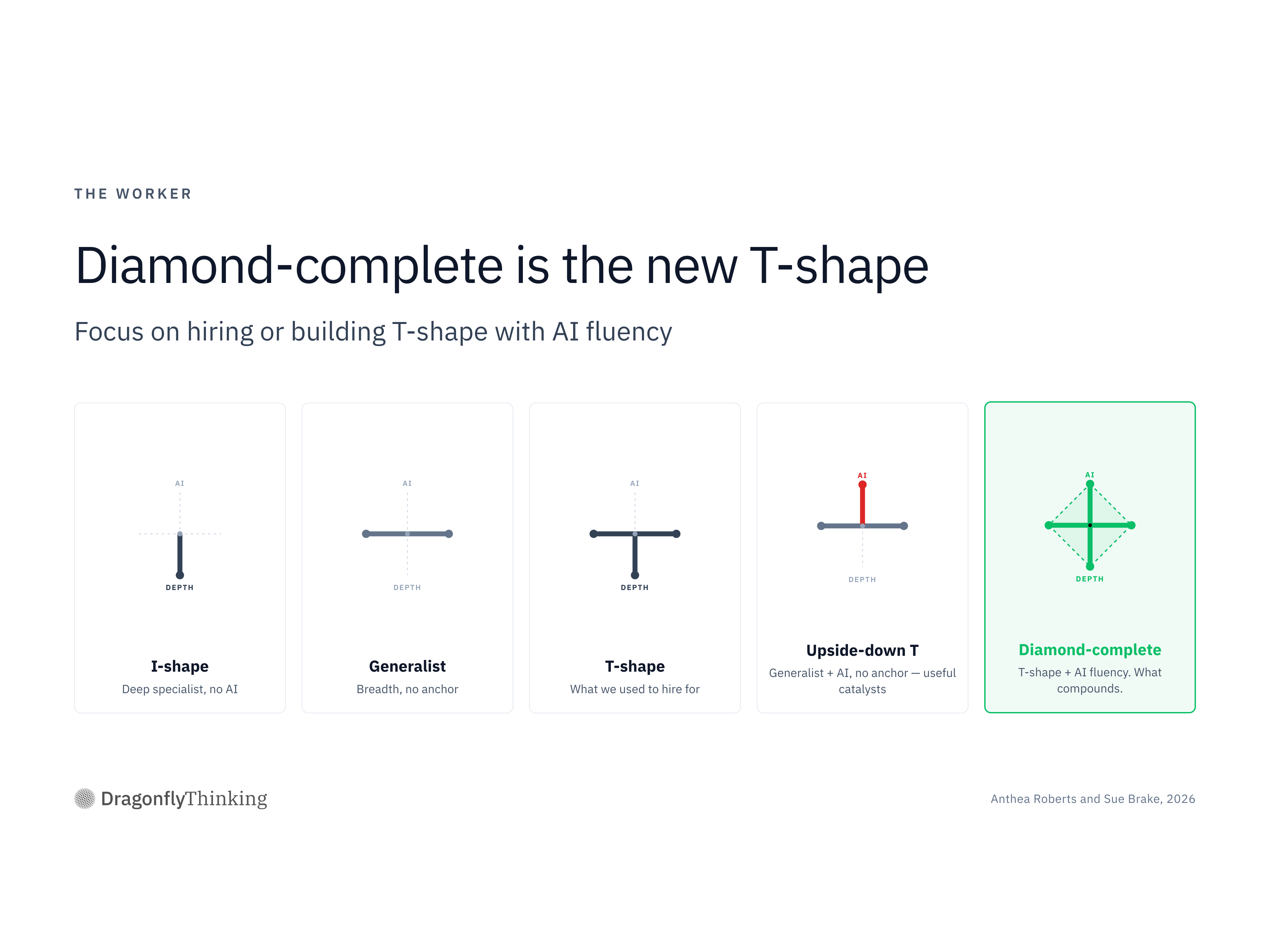
Here's the formula I keep coming back to: human expertise × AI expertise × AI capability. Multiplicative, not additive. If any term is zero, the product is zero. A brilliant domain expert with no AI skills stays at 1x. A brilliant prompt engineer with no domain knowledge stays at zero-to-one. Compounding happens when you bring both.
This is what separates vibe coding from vibe engineering. What separates casual use from the structured systems of Amplifier or Compound Engineering. Those systems work because the people behind them have deep domain expertise and deep AI expertise and they rebuilt everything from scratch to be human × AI native.
Not everyone will want to make this shift. That's fine. But if you're feeling the squeeze, this might be the way through: stop thinking of AI as a tool that speeds up your existing work. Start thinking of it as a domain requiring its own mastery, one that multiplies with what you already know.
Your domain expertise isn't obsolete. It's one of the multipliers. But on its own, it's not enough anymore.
References
© Anthea Roberts, 2026
Stay informed
Where AI meets strategic thinking.
New analysis on AI, strategy, and the intersection of both — from the team building tools to make better decisions, not just faster ones.